
Getting Lac Qui Parle County Court Records
The fastest route is Minnesota Court Records Online (MCRO). Search by case number there for an eligible public case, its ROA, or a document. Keep two limits in mind. MCRO is not a certified record, and not every document shows up remotely. Is the display thin? Do you need an official copy? The courthouse public-access terminal and Lac Qui Parle County District Court Court Administration are the next channels.
Court Administration sits with Minnesota District Court, Lac qui Parle County. The address is 600 Sixth Street, Madison, MN 56256. The telephone number is (320) 295-4000. The official court page lists regular hours of 8:00 a.m. to 4:30 p.m. You can use the local request process, a statewide copy-request form, or a letter. Staff can also explain how to submit and pay for a specific record.
- Find the case number, party names, event, or document date through MCRO if possible.
- Specify the county, court, document or event, date range, and desired copy type.
- Ask whether the requested record is public and remotely available, on site, or subject to a rule or order.
- Use Court Administration for inspection, a local request, or a certified or exemplified copy.
- Verify the payment method before mailing a check, money order, or sensitive payment information.
Lac Qui Parle ROA and Records
Think of the Register of Actions as a running index. It lists filings and proceedings in order. Each entry can point to a pleading, motion, order, judgment, exhibit, transcript, or payment entry. The index is not the document itself. A missing view link beside a document index number does not mean no filing exists.
Two official tools sit behind all this. Minnesota eFile and eServe handles filing and service. Minnesota Statutes § 485.07 spells out the Court Administrator's register of actions, judgment roll, judgment docket, and indexes.
Knowing the difference between an ROA entry and the filed document pays off. It lets a Lac Qui Parle requester describe exactly what should be copied, which speeds up the whole request.
Court Record Types
A court file can hold many kinds of items. Pleadings, motions, affidavits, notices, orders, judgments, exhibits, transcripts, financial records, and more may appear. Access splits three ways. Some items are public through MCRO. Some require the courthouse terminal or a custodian. Some are confidential or sealed. That split matters. Asking for a full file, a report, a specific order, or a single docket page raises different access and fee questions.
Word your request around the file, not the person. Name the case and the document you want. Ask for that instead of all records about someone. The court can then say whether the item is public and which channel fits.
Lac Qui Parle MCRO Coverage
MCRO's reach depends on when a document was filed. For documents filed on or after July 1, 2015, it provides all documents in major and minor criminal and civil cases, plus listed formal probate, other probate, guardianship, conservatorship, and trust categories, subject to access rules. Family and post-adjudication paternity coverage is much narrower. The Judicial Branch also describes added court-generated judgments, orders, opinions, and notices for remote-access types from July 1, 2005 through June 30, 2015.
Before that, coverage thins out. If an old Lac Qui Parle file is not online, do not read a missing download as a missing court record. Use the case number and call the local Court Administrator.
Exhibits and transcripts are special cases. They can carry their own inspection or production requirements. Name the item and the event date, then ask what record-access rule, request method, and fee applies. The court can tell a public document link apart from a record that must be inspected or requested through Court Administration.
Lac Qui Parle Madison Copy Counter
Need to make a Lac Qui Parle court record request? The local Court Administrator is the practical contact. Bring or send the case number. Include the item you want, the date range, and the copy type. A file may be public but not downloadable. Staff can then say which channel fits. Inspection at the courthouse, a local copy request, or a statewide form or letter are the options.
Call before you travel. Some records need advance retrieval or a particular payment method. Staff can also tell a request to inspect apart from a request for a certified court copy.
Inside a Lac Qui Parle County Court Record
What you can see in a court file depends on the record type. The ROA gives the dated pathway. A copy request targets the document or output that follows it. An official recipient may demand a certified copy. A plain copy often serves for ordinary reading.
| Case identifier | The court number that connects the request to the right Lac Qui Parle file. |
|---|---|
| Case title and category | The displayed parties and classification, which help distinguish the record. |
| ROA event | The dated filing or court action used to identify the requested document. |
| Document index | An index reference that may lead to a public document or a custodian request. |
| Order or judgment | A court-issued record that may need a certified or exemplified format. |
| Access designation | Public, confidential, sealed, or otherwise restricted under a rule or order. |
Plain, Certified, Exemplified Copies
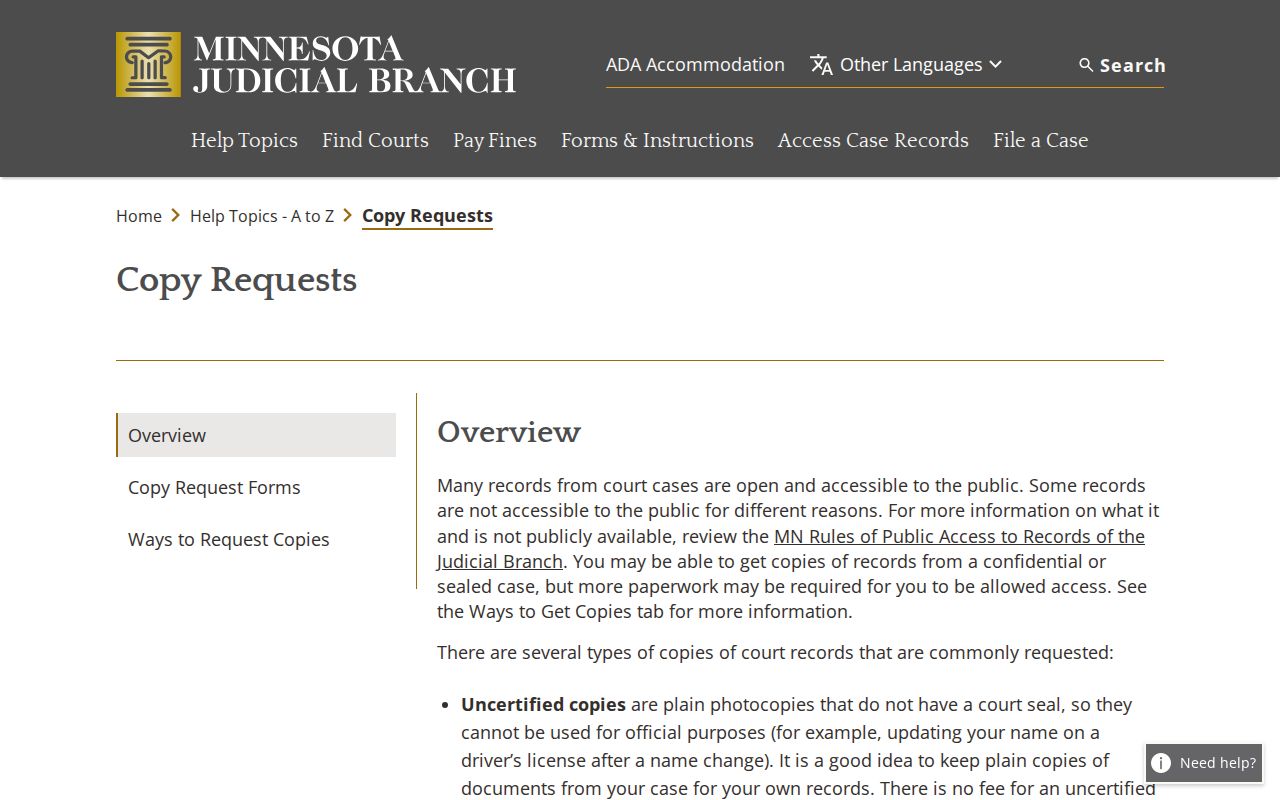
Copies come in three flavors. A plain, uncertified copy works for ordinary reference. A certified copy bears the court seal when an official recipient requires certification. An exemplified copy adds the signatures of the judicial officer and Court Administrator. That format is often for use in another jurisdiction. Certified and exemplified can both be applied to one document. Say whether you need one document, a report, multiple docket pages, or a scan. The official copy-request guidance walks through the formats.
Pick the format up front. That single step helps Lac Qui Parle Court Administration quote the correct request and copy process right away.
Fees and Certified Copies
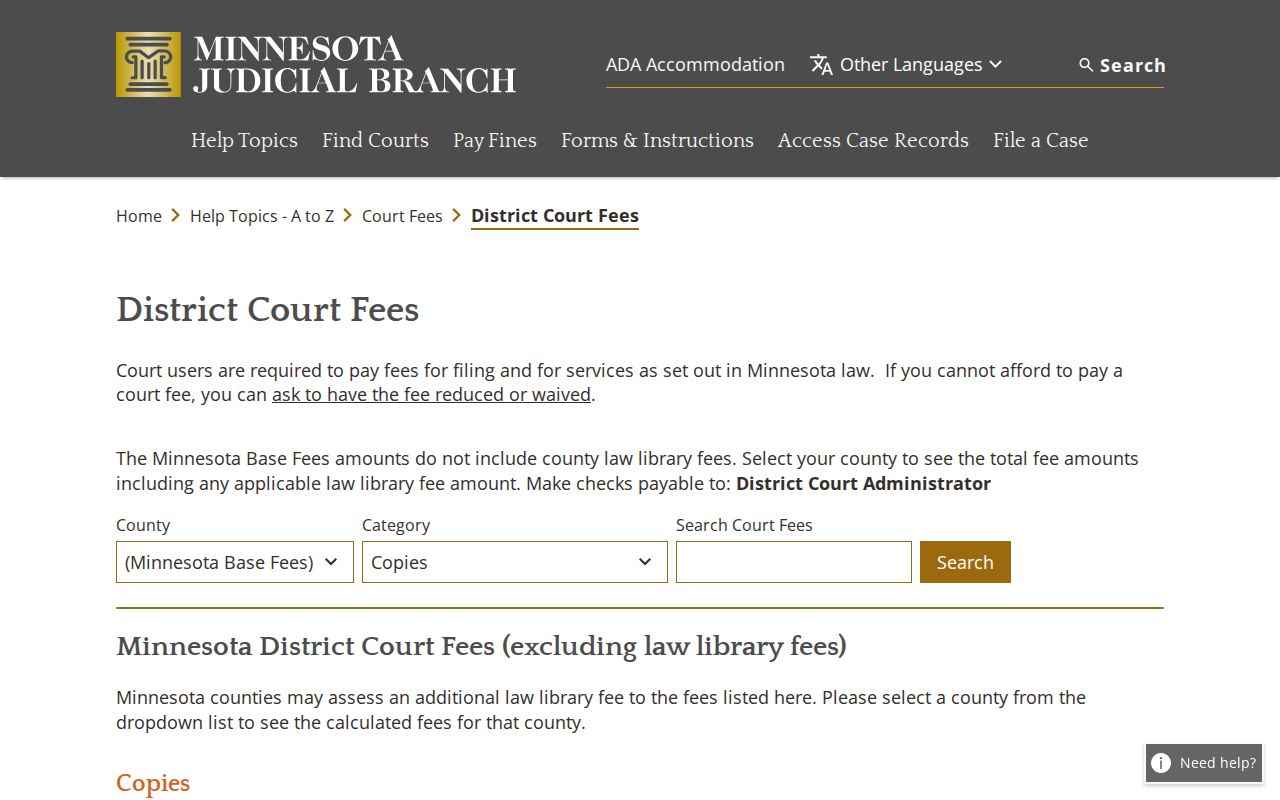
Looking for copies of a Lac Qui Parle County court docket? Statewide district-court fee guidance charges nothing for ordinary uncertified copies. Printouts, scans, and screen prints are also free. A certified copy runs $14. An exemplified copy is $14. Getting both together costs $28. Different lines may apply to reports, larger scanning requests, and county law-library fees. Confirm the final amount with Court Administration before you pay.
| Requested item | Current listed fee | Record-access note |
|---|---|---|
| Plain copy, printout, scan, or screen print | $0 | Current statewide district-fee guidance; verify local request details. |
| Certified copy | $14 | Per document when certification is required. |
| Exemplified copy | $14 | Per document; may be needed for another jurisdiction. |
| Certified and exemplified copy | $28 | Both forms for one document. |
The official district fee search provides the current fee category.
Treat the old $8 eFS optional-service figure with care. The current statewide copy guidance does not match it, so ask Court Administration what a plain copy costs at the counter today.
Lac Qui Parle eFS and MCRO
Minnesota eFile and eServe (eFS) handles filing and service of court documents. It is not a portal for browsing court dockets. Attorneys and government participants face statewide eFS requirements, while self-represented parties may use it too. Filers must label public, confidential, or sealed material as required. Someone who just wants a public Lac Qui Parle record will normally turn to MCRO or Court Administration instead of an eFS login.
The official eFS resources page describes filing and how confidential material gets handled.
Those access controls matter for readers. A public register of actions and the filed document itself are not the same thing in Lac Qui Parle County, and the gap between them is built into the system.
Sealed Records and Public Access
Access rules come from the Minnesota Rules of Public Access to Records of the Judicial Branch. Rule 4 lists what is excluded or restricted. Rule 8 covers inspection, copying, remote access, and registers, plus the limits on each. Juvenile files and sealed cases need a closer look. So do confidential records, protective orders, and civil-commitment matters. A clerk checks each file before releasing anything. A name alone never opens private material. A case number does not either.
Request with the rule in mind. Ask Court Administration what rule or order controls a limited record. Court records are governed by Judicial Branch rules, and Minnesota Statutes § 13.90 explains that the judiciary is not handled under the general Data Practices Chapter 13 scheme in the same way as executive agencies.
The 2024 eFS valid-email notice explains the change for eFS document links.
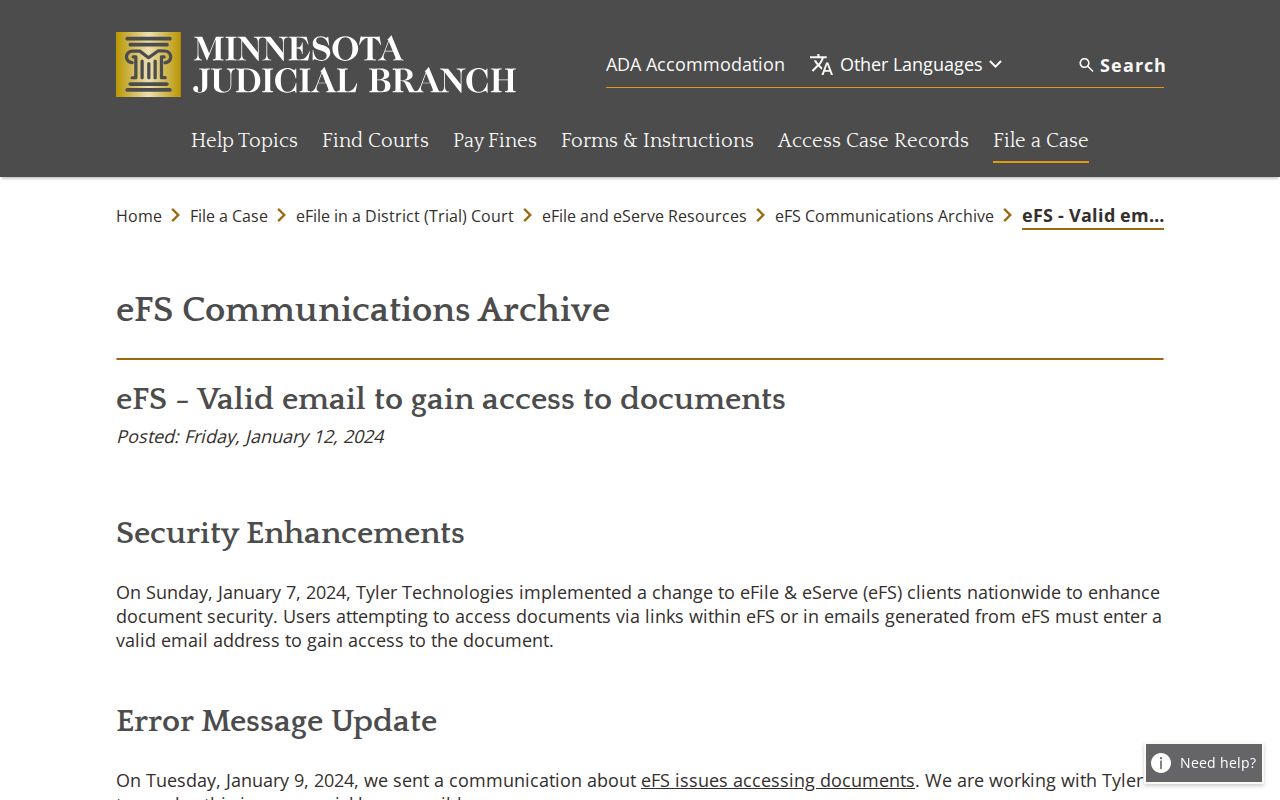
That filing-system notice changes nothing for public access to a Lac Qui Parle County court record. MCRO and Court Administration remain the open routes.